
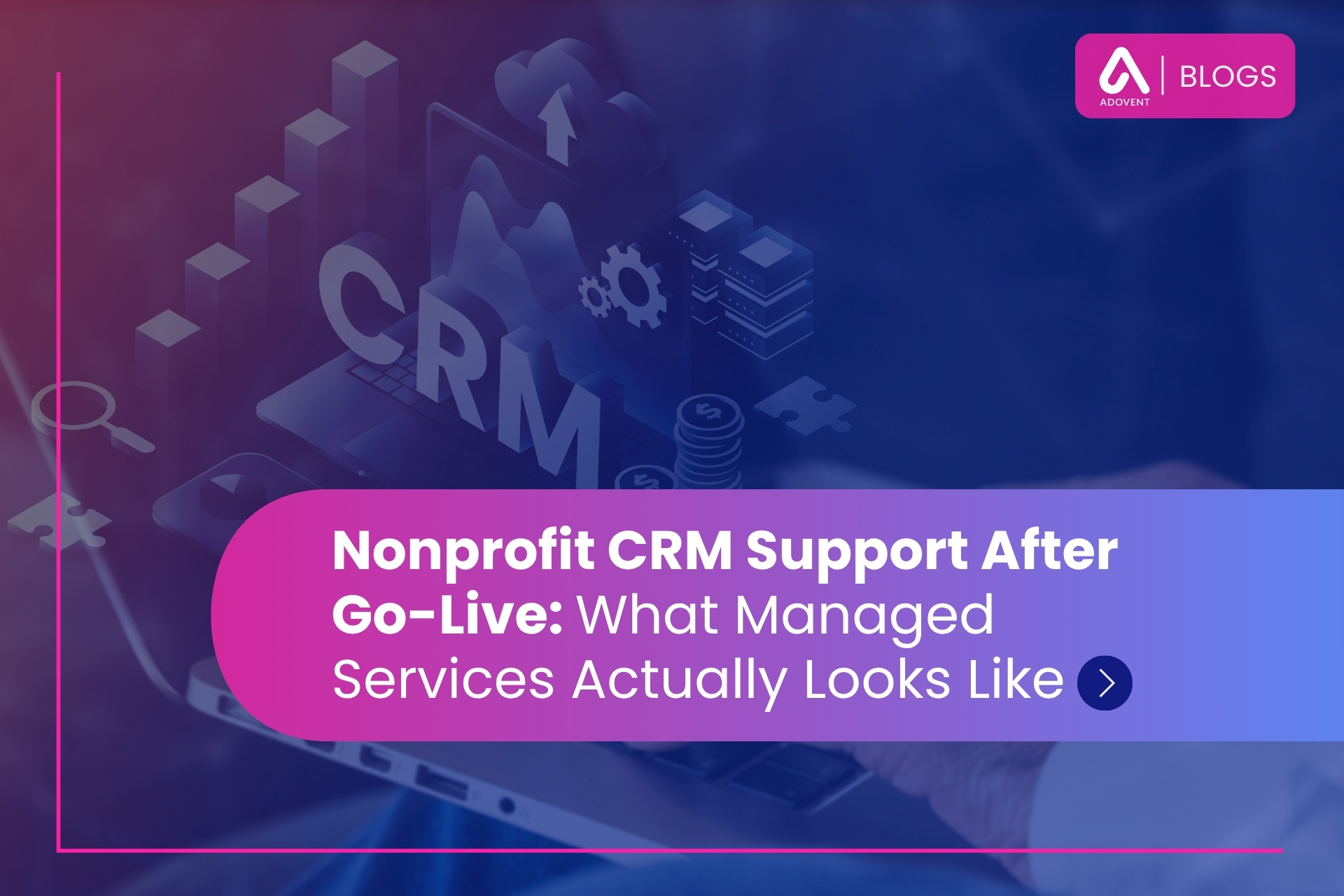
Nonprofit CRM Support After Go-Live: What Managed Services Actually Looks Like
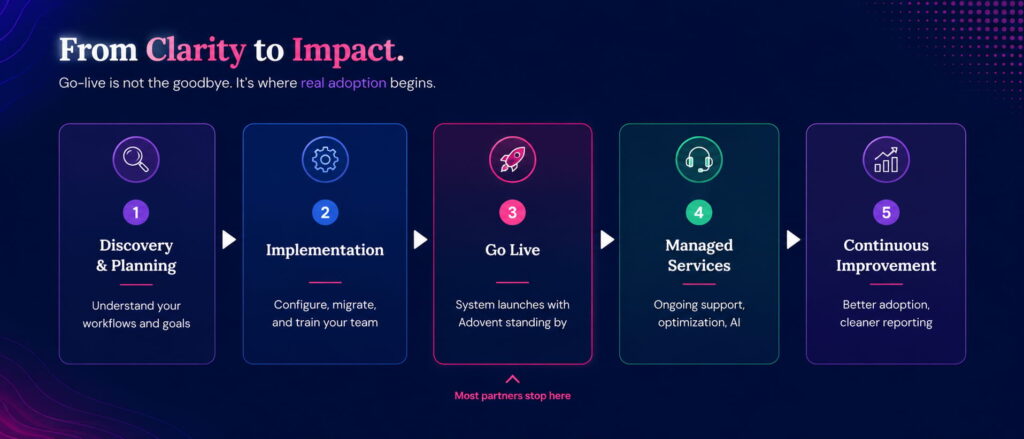
The most expensive moment in a nonprofit CRM investment is not the implementation. It is the six months after go-live, when the implementation team has stepped back, the system is technically live, and the organization quietly starts to realize that live and working are not the same thing.
Staff are logging in but not logging data. Board reports require the same manual cleanup they always did. The fundraising pipeline in the system does not match what the development team actually knows. Leadership is starting to ask the same questions the CRM was supposed to answer.
This is not a software failure. It is a support model failure. And it is the most common and most avoidable technology problem nonprofits face.
Why go-live is the beginning, not the end
Most nonprofit technology budgets are heavily front-loaded. The majority of the investment, time, money, and organizational attention, goes into selection, configuration, data migration, and launch. What receives far less investment is everything that determines whether the system actually becomes useful.
Real adoption takes longer than any implementation timeline. It happens as staff encounter situations the training did not cover. As reports reveal that the initial configuration does not quite match how the organization actually operates. As leadership starts using the data and discovers that some of it cannot be trusted yet.
None of this is unusual. All of it is predictable. And all of it requires ongoing support from someone who understands both the platform and the specific operational context of running a nonprofit.
Without that support, organizations develop a pattern that is remarkably consistent. Staff build workarounds. Workarounds become habits. Habits become the new normal. And twelve months after a significant technology investment, the organization is essentially managing operations the same way it did before the system went live, just with a more expensive piece of software in the background.
What nonprofit CRM managed services actually covers
Managed services is a term that gets used loosely in the technology industry. For nonprofits evaluating post-go-live support options, it is worth being specific about what it should include.
System administration and configuration updates
A CRM is not a static tool. As programs change, as new grants come online, as the organizational chart shifts, the system needs to reflect the new reality. Fund structures need updating. User permissions need adjustment. Workflows that made sense at launch need refinement as the team learns how they actually want to work.
A managed services relationship ensures that these updates happen consistently and correctly, rather than accumulating as a backlog that eventually requires another expensive engagement to address.
Adoption support that goes beyond the go-live window
Training delivered before go-live addresses a theoretical version of the system. Real adoption support addresses the actual version, the one staff encounter when they are trying to complete real work under real time pressure.
This means being available to answer specific questions as they arise. It means reviewing how the system is being used and identifying where workflows are breaking down. It means recognizing when a configuration decision made at implementation is creating friction for staff, and knowing how to adjust it.
Most implementation partners are not structured to provide this kind of ongoing adoption support. Adovent is. It is built into how we engage after go-live.
Reporting refinement as organizational needs evolve
The reports that seemed sufficient at go-live rarely stay sufficient for long. As board expectations evolve, as grant reporting requirements change, and as leadership becomes more sophisticated in how they use the data, the reporting layer needs to keep pace.
Managed services includes regular reporting review, identifying where the current setup is not giving leadership what they need, and configuring the system to close that gap without requiring a new implementation engagement.
Strategic guidance as the platform matures
Over time, a well-supported CRM becomes a platform for expanding capability, integrating practical AI, connecting to ERP for unified reporting, building more sophisticated pipeline visibility, or adding automation to workflows that are currently manual.
A managed services partner who understands both the technology and the nonprofit’s operations can guide these expansions at the right pace — identifying which improvements will have the most impact, sequencing them in a way that does not overwhelm the team, and implementing them without disrupting the systems that are already working.
The difference a managed services partner makes to reporting confidence
One of the most visible places where post-go-live support pays off is board reporting. When a CRM is well-supported after implementation, the monthly preparation for a board meeting stops being a cleanup exercise. The data is accurate because the workflows were designed to produce accurate data. The reports exist because the reporting layer was configured and refined over time to reflect what leadership actually needs.
When a CRM is not supported after implementation, the opposite happens. Finance and development data diverges. Pipeline reporting becomes unreliable. Leadership loses confidence in the numbers. And the staff member who is supposed to be managing relationships ends up spending two days before every board meeting trying to reconcile spreadsheets.
The difference between those two outcomes is not which CRM the organization selected. It is whether they had a partner who stayed close enough to help the system keep getting better.
What to look for in a nonprofit CRM managed services partner
Not every technology partner offering managed services is structured to deliver what nonprofits actually need after go-live. The right partner brings three things together.
Deep platform knowledge, specifically of SylogistMission CRM and ERP, and the Microsoft-based ecosystem it sits within. Generic CRM support from a partner without SylogistMission expertise will not address the specific configuration, workflow, and reporting decisions that determine whether the platform performs.
Nonprofit operational understanding, the ability to translate what the technology can do into what the organization actually needs. This means understanding how development teams think about donor relationships, how finance teams think about restricted fund compliance, and how board members think about organizational performance.
A commitment to the relationship after go-live, a support model that does not treat launch as the end of the engagement. Adovent’s managed services model is built around the principle that go-live is not the goodbye point. It is where the real work of turning a system into a genuine operational asset begins.
AuthorBio

Devanshi Chauhan,
Content Creator
Meet Devanshi Chauhan, a creative content creator at Adovent who brings ideas to life through engaging and relatable storytelling. With a sharp eye for detail and a natural sense of what resonates with audiences, she creates content that feels both fresh and authentic. Devanshi blends creativity with strategy, crafting digital experiences that leave a lasting impression.
